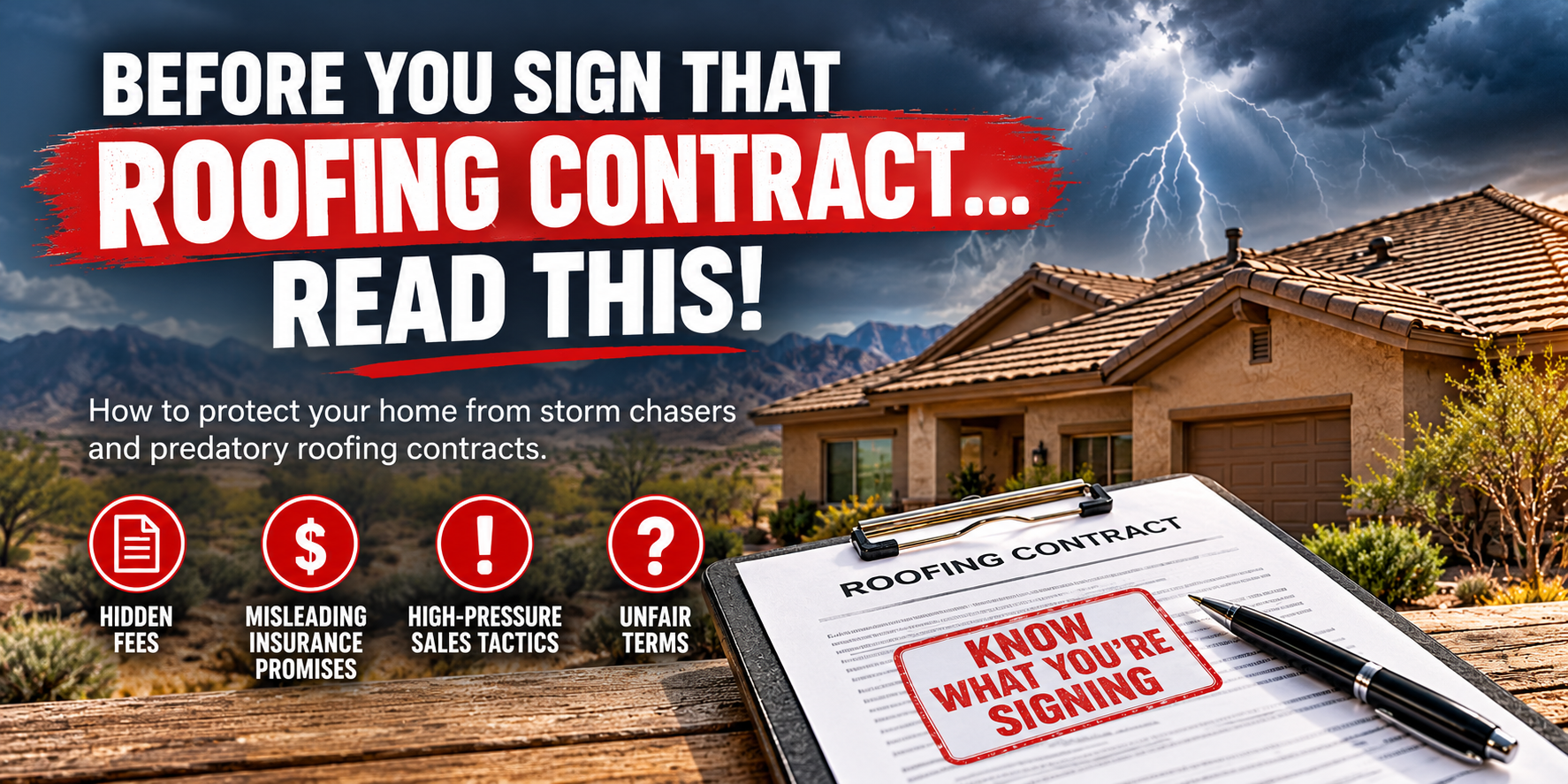
Before You Hire: How to Look Up a Contractor and Understand Their Arizona Registrar of Contractors Report
A Homeowner's Guide to Protecting Your Property, Your Investment, and Your Peace of Mind
When your roof starts leaking, a storm causes damage, or you're preparing for a major home improvement project, finding a contractor you can trust becomes a top priority.
But how do you know if the company you're considering is properly licensed? What if they have complaints against them? And what should you look for before signing a contract?
The good news is that Arizona homeowners have access to a valuable, free resource: the Arizona Registrar of Contractors (AZ ROC).
At Northern Arizona Roof Services and Roof Services of Arizona, we believe informed homeowners make better decisions. That's why we're walking you through how to research a contractor, understand their licensing report, and recognize potential red flags before hiring.
What Is the Arizona Registrar of Contractors?
The Arizona Registrar of Contractors is the state agency responsible for licensing and regulating contractors performing residential and commercial construction work throughout Arizona.
Its mission is to protect the health, safety, and welfare of the public through contractor regulation.
The AZ ROC provides an online search tool that allows consumers to research a contractor's licensing information, including license status, classifications, bonding information, and complaint history.
And the best part? It's free and available to the public.
Step 1: Visit the Arizona Registrar of Contractors Website
Start by visiting the official website: www.roc.az.gov
From the homepage, click on the Search Here button.
Avoid relying solely on a contractor's website, social media page, advertisement, or business card to confirm licensing. Always verify the information directly through the state.
Step 2: Search for the Contractor
The contractor search allows you to look up a company using identifying information, such as its business name or Arizona ROC license number.
Our recommendation: Ask the contractor for their ROC license number before beginning your research.
- Searching by license number can help eliminate confusion between businesses with similar names.
- If you're searching by company name, remember that some businesses operate under a registered trade name or DBA (Doing Business As), which may differ from their legal business name.
- For example, a company may advertise under one name while its contractor's license is registered under another.
- The DBA should appear along with the registered trade name in the search results.
- If you can't find the company, ask for its legal business name and license number.
- A legitimate contractor should be willing to provide this information.
Step 3: Check the License Status
Once you've located the contractor, one of the first things to review is the license status.
Here are some common statuses and what they mean:
- Active: The license is currently active. You should still verify that the classification covers your specific project.
- Suspended: The contractor's licensing privileges have been suspended. Do not assume the company can legally perform your project.
- Revoked: The license has been revoked by the Registrar. A revoked license does not authorize contracting.
- Expired: The license is no longer current and must be addressed before the contractor undertakes work requiring a license.
- Inactive: The license is not currently active for contracting.
Important: A contractor who was licensed five years ago is not necessarily licensed today. Check the license before signing your contract, even if you've worked with the company previously.
Check the license before signing your contract, even if you've worked with the company previously.
Step 4: Review the Complaint History
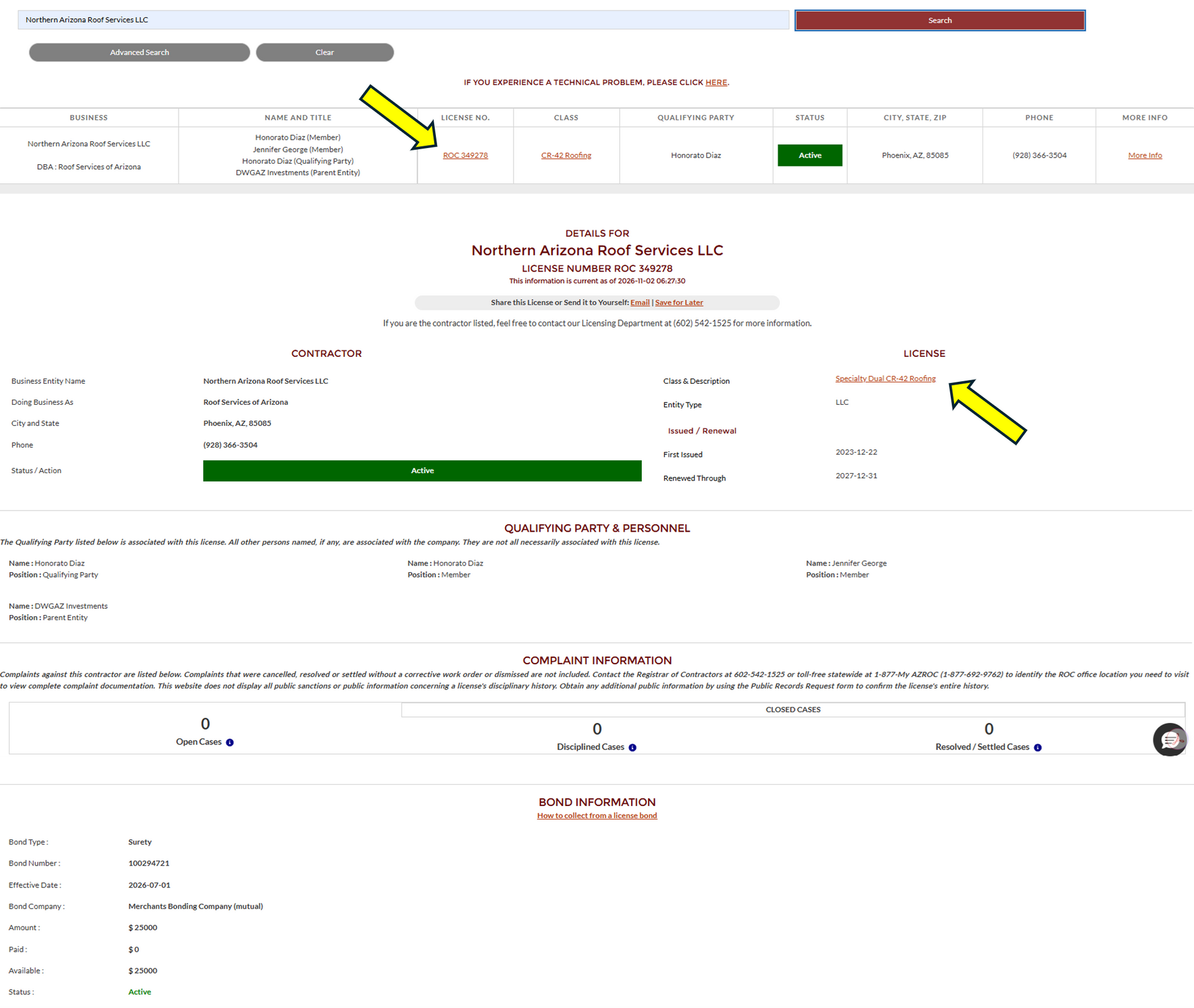
Click on the license number to view the license details. This is one of the most valuable sections of a contractor's report and one that homeowners should take time to understand.
The AZ ROC investigates complaints involving licensed contractors, including allegations of workmanship deficiencies and other violations.
When reviewing complaint information, pay attention to the following:
- Was a complaint filed?
A complaint indicates that someone raised a concern. It does not automatically mean the contractor violated a law or workmanship standard. - Was the complaint substantiated?
Look for information indicating whether an investigation identified deficiencies or violations. - Was corrective action required?
In some cases, the ROC may issue a written directive requiring a contractor to correct deficiencies. - Was the complaint resolved or dismissed?
A complaint may be closed because the contractor completed corrective work, the work met applicable standards, or the matter was otherwise resolved. - Is there a pattern?
Multiple complaints involving similar issues, particularly when accompanied by substantiated findings or disciplinary action, deserve closer examination.
Does a Complaint Automatically Mean a Contractor Is Bad?
Not necessarily.
Construction projects involve multiple people, materials, weather conditions, schedules, and expectations. Disagreements can happen.
What's important is understanding the circumstances and how the contractor responded.
A company that takes responsibility, communicates with customers, and completes appropriate corrective work should be evaluated differently from one that repeatedly ignores legitimate concerns.
Also, keep in mind that the ROC's online complaint history is not necessarily a complete record of every complaint ever filed. Closed complaints generally appear online for two years after closure.
Our advice: Don't judge a contractor solely by the number of complaints. Take time to understand the findings, resolutions, and any disciplinary actions.
Step 4: Understand the License Classification
Did you know that not all contractor licenses authorize the same type of work?
Arizona issues different license classifications based on the type of construction services a company is qualified and authorized to perform.
For example, a contractor licensed for painting is not automatically authorized to perform a complete roof replacement.
When reviewing the report, look for the license classification and confirm that it covers the work you're requesting. To verify the types of work a contractor is licensed to perform, navigate to the contractor's detail page and click the license type hyperlink under the “Class & Description” section. This will provide additional information about the scope of work permitted under that license classification.
Likewise, residential and commercial work may require different licensing classifications.
If you're unsure whether a classification is appropriate, contact the AZ ROC directly for clarification.
A current license is important, but having the correct license classification is equally important.
Step 6: Look for Disciplinary Actions
Complaint information and disciplinary actions are not the same thing.
Disciplinary action can occur when the ROC determines that a contractor has violated applicable requirements and issues an enforceable order.
Depending on the circumstances, disciplinary outcomes may include license suspension, revocation, or other penalties.
If you see disciplinary action on a contractor's record, investigate further.
Ask what occurred, when it happened, whether corrective action was completed, and whether the license is currently in good standing.
If necessary, contact the ROC for clarification or request additional public records.
Step 7: Review Bond Information
Arizona contractors are required to maintain a contractor's license bond as part of the licensing requirements.
The ROC report can provide information about the contractor's bond.
However, it's important to understand that bonding and insurance are not the same thing.
A contractor's license bond provides certain protections under Arizona law, subject to eligibility requirements and limitations.
Insurance, on the other hand, may provide coverage for specific risks, such as property damage or liability arising from the contractor's operations.
Before hiring a contractor, consider requesting proof of:
- General liability insurance
- Workers' compensation coverage, where applicable
- Any additional coverage appropriate for your project
Don't assume that a company is fully insured simply because its ROC license is active.
Step 8: Verify the Business Information
Review the business details listed in the contractor's report.
Compare the licensed business name, license number, and available contact information with the estimate or contract you've received.
If someone approaches you claiming to represent a particular roofing company, verify that they are actually associated with that company.
One way to do this is to contact the business using the telephone number listed in the ROC record rather than relying exclusively on a number provided by a salesperson.
This is especially important following severe weather, when homeowners may be approached by unfamiliar contractors offering immediate repairs.
Red Flags Homeowners Should Never Ignore
Before signing an agreement, be cautious if a contractor:
- Refuses to provide an ROC license number.
- Claims to be licensed but cannot be found in the ROC database.
- Uses another company's license number.
- Has a license that is suspended, revoked, or expired.
- Does not have the proper classification for the proposed work.
- Pressures you to sign immediately without allowing time to review the contract.
- Requests a large payment without clearly documented terms or a defined scope of work.
- Refuses to provide a written estimate or contract.
- Cannot explain significant disciplinary actions or unresolved concerns.
Following major storms, homeowners may feel pressured to act quickly to prevent further damage.
While addressing an active leak is important, don't let urgency prevent you from doing your research.
A few minutes spent verifying a contractor can help protect you from potentially costly problems.
Beyond the ROC Report: Additional Questions to Ask
An ROC search is an excellent starting point, but it shouldn't be the only factor in your decision.
Before selecting a roofing contractor, ask about their experience with your specific roofing system, request references, review their workmanship warranty, and confirm who will supervise the project.
You should also request a detailed written scope of work that identifies the proposed materials, installation methods, project cost, payment terms, and other important expectations.
Remember, the lowest bid isn't always the best value.
Quality materials, proper installation, experienced crews, clear communication, and accountability all contribute to the long-term performance of your roof.
Take Five Minutes Before You Sign
Your roof protects one of your most valuable investments.
Before hiring a contractor, take five minutes to visit the Arizona Registrar of Contractors website, verify their license, review their history, and ask questions.
Those five minutes could save you significant frustration, exense, and uncertainty down the road.
Do your homework. Ask questions. Hire with confidence.
Helpful Resources
Arizona Registrar of Contractors
Website: www.roc.az.gov
Phone: 602-542-1525 or 877-692-9762
Have Roofing Questions? We're Here to Help.
Northern Arizona Roof Services and Roof Services of Arizona provide residential and commercial roofing services throughout Northern Arizona and the Greater Phoenix area.
From inspections and repairs to complete roofing systems, our team is ready to help you protect your property.
Northern Arizona: 928-366-3504
Greater Phoenix Area: 623-810-9265
Website: www.northernarizonaroofserivices.com